The Blog
Agent Mission Workflow: letting agents run my projects, and keeping only the decisions
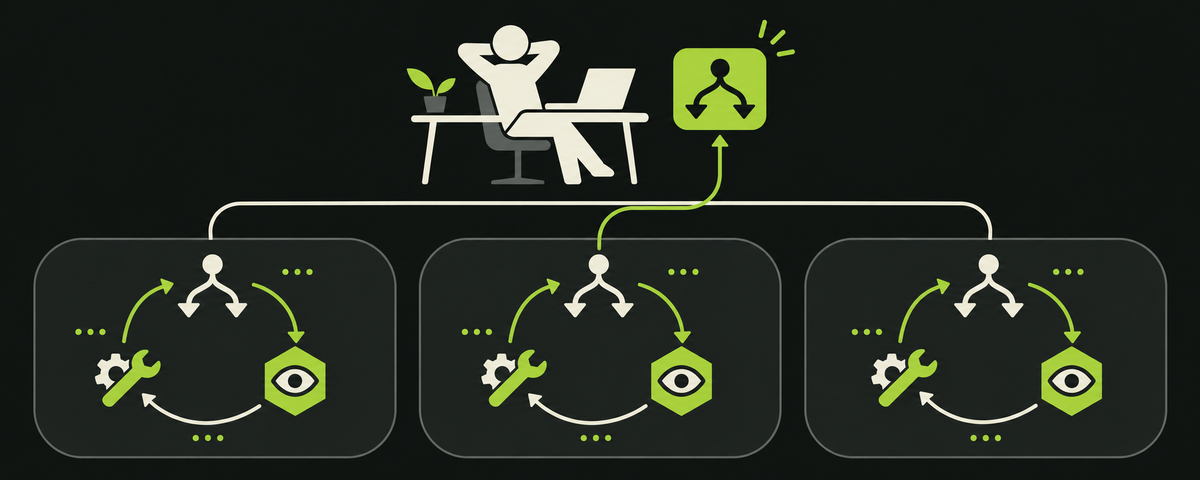
Episode 1 of the “Agent Mission Workflow” series — handing an idea to a pilot, letting agents work, and taking back control when a decision deserves my attention.
A coding agent doesn’t need me to find a bug. It needs me to decide what to do about it.
What it is
Agent Mission Workflow is an open source project I use to have coding agents work on my projects. A pilot agent prepares and hands out the work, other agents carry it out, an agent from another model reviews it, and I keep only the decisions. It all fits in plain files, a small script and a layout for Herdr, the tool that runs the agents’ terminals.
It answers a concrete problem: driving several agents by hand means copying prompts from one terminal to the next, rereading long logs to find out where each one stands, and remembering who is working on what. The question behind it: when does a project really need me?
The idea in one picture
me ─── idea, brief ──────► pilot (Claude Code)
 ▲                           ├── step ───► executor (Claude Code)
 │                           └── review ─► reviewer (Codex, another model)
 │
 └── ■ reserved decision ◄── question + recommendation + alternative
       (scope, merge, publication, extra review)
A mission is a framed request: a goal, success criteria and a verdict at the end. A pilot agent frames each mission, splits it into verifiable steps, hands them out and routes the reviews. Each step is done by a separate executor, in the project folder. An independent reviewer, from another model, checks the result adversarially: Codex reviews what Claude Code wrote.
And I, the owner, keep only the reserved decisions, marked ■: a change of scope, a merge, a publication, one more review than planned. For everything else, I ask for a status in one sentence.
Everything needed to resume lives in files. A restarted agent, or a different one, picks up where the previous one stopped.
One mission, from my side
On 14 November, a mission was adding three labs to GitHub Action Labs, my local training environment for GitHub Actions. The Codex reviewer showed that the validator of lab 4, meant to prove a real integration test against Redis, accepted a step that merely printed the two expected lines:
- name: Run the integration test
  run: |
    echo 'Connexion à Redis : localhost:6379'
    echo '1 passed'
No pytest, no Redis. The pilot checked the finding in the code, then asked me a question: authorise a fix and one more review. It came with its recommendation, the alternative and their consequences. I said yes. The executor fixed the validator, and Codex’s next review confirmed the problem was closed.
I neither found nor fixed the bug. I decided.
What it changed in how I manage my projects
Several projects at once
As of 28 November 2026, the registry holds 9 projects and 46 missions, 35 of them closed. Among those projects: GitHub Action Labs, my Creole tales (contes-creole), laptop-bootstrap, this blog, and Agent Mission Workflow itself. I no longer keep that list in my head: it lives in a file the pilot rereads.
Working in parallel without collisions
On 28 November, three missions on the same repository ran in parallel, each in its own worktree: a folder of architecture decision records, a quick start guide and an alias to open Herdr App. The first two, reviewed by Codex, were merged as PR #3 and PR #4. It’s the pilot’s job, not mine, to keep their changes apart: each mission works in its own worktree, isolated from the others.
A status in one sentence
“Fais-moi le point” (give me a status update) is enough. The pilot’s first test showed it: a fresh session, with no conversation context, found in two minutes where each mission stood and what was waiting for me, from the files alone. And when a decision is waiting for me, it always comes with a recommendation and an alternative: I can decide without reopening the case.
Reviews that find real problems
The two echo lines are the example. Codex doesn’t take the executor’s report at its word, and that’s why it finds things.
Resuming after a reboot
During the GitHub Action Labs mission, the computer rebooted in the middle of the tests. Herdr restored the terminals, and the pilot relaunched the executor to rerun the tests; the recovery took me about a minute.
Herdr: what I see when I come back
When I come back to the terminal, Herdr App shows the agents and their terminals, and my layout puts the pending decision above the active terminal, not in its scrollback. The mission, its decision and its criteria come from the workflow’s files: Herdr knows nothing about my missions.
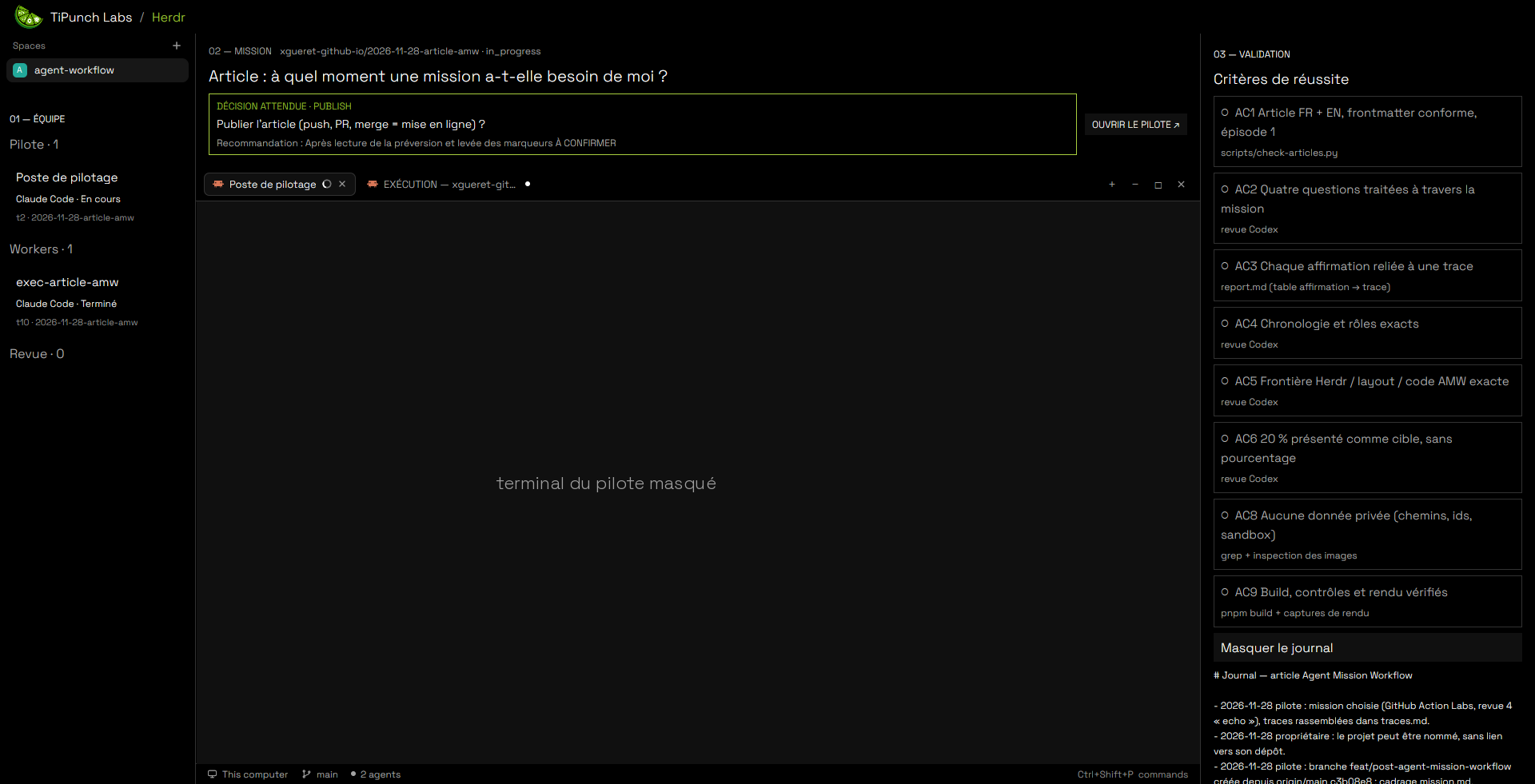
The mission that produced this article: the publication decision waits above the pilot’s terminal, masked here.
What it doesn’t do (yet)
- My attention isn’t measured yet. The target: my active time on a mission stays under 20 % of what it would be without the workflow. The pilot logs my interventions in estimated minutes, but no ratio is measured so far.
- Reviews depend on the reviewer’s environment. On the GitHub Action Labs mission, Codex had no Docker: end-to-end execution relied on the executor, and the review on its evidence.
- The panels only show work in progress. A closed mission no longer shows up.
- Merging is not validating. The GitHub Action Labs mission closed on a partial verdict, with ten open items: I authorised the merge while stating that it “ne transforme pas les parcours non vérifiés en parcours validés” (does not turn unverified paths into validated ones).
The role of vibecoding in this project
Agent Mission Workflow is built with agents: as of 28 November 2026, 20 of the repository’s 24 commits carry a Claude model’s signature, and the other four are merges. This article follows the same path: the pilot chose the mission and gathered the traces, a Claude Code executor wrote from those traces, and Codex reviewed. Publishing remains my decision.
Going further
So, when does a project really need me? When it hits a limit I wrote, when a recommendation doesn’t cover every case, when a scope, a merge or a publication has to be decided.
The code is open, under the MIT licence: TiPunchLabs/agent-workflow. Under the hood: TOML registries for projects and missions, Markdown files for each mission, and a bin/aw Python script, with no external dependency, that validates and summarises them.
To try it, you need Linux and git, Python 3.11 or later, Claude Code for the pilot and executors, Codex CLI for the reviewer, and jq if you use Herdr’s terminal-version commands. Herdr is required: it is how the pilot starts the agents and talks to them, in Herdr App or in its terminal version. The quick start guide goes from git clone to the first “Fais-moi le point”. To understand the choices, the architecture decision records explain why Claude Code pilots and Codex reviews, why state lives in files, and what stays reserved to the owner.
The next episodes will go into detail: the two-echo mission end to end, onboarding an existing repository, then reproducing the Herdr layout. If you have several agents working on your projects, I’m curious to see where you place your own reserved decisions: write to me, and let’s compare setups.
In the end, the point is being able to manage several projects at the same time.